

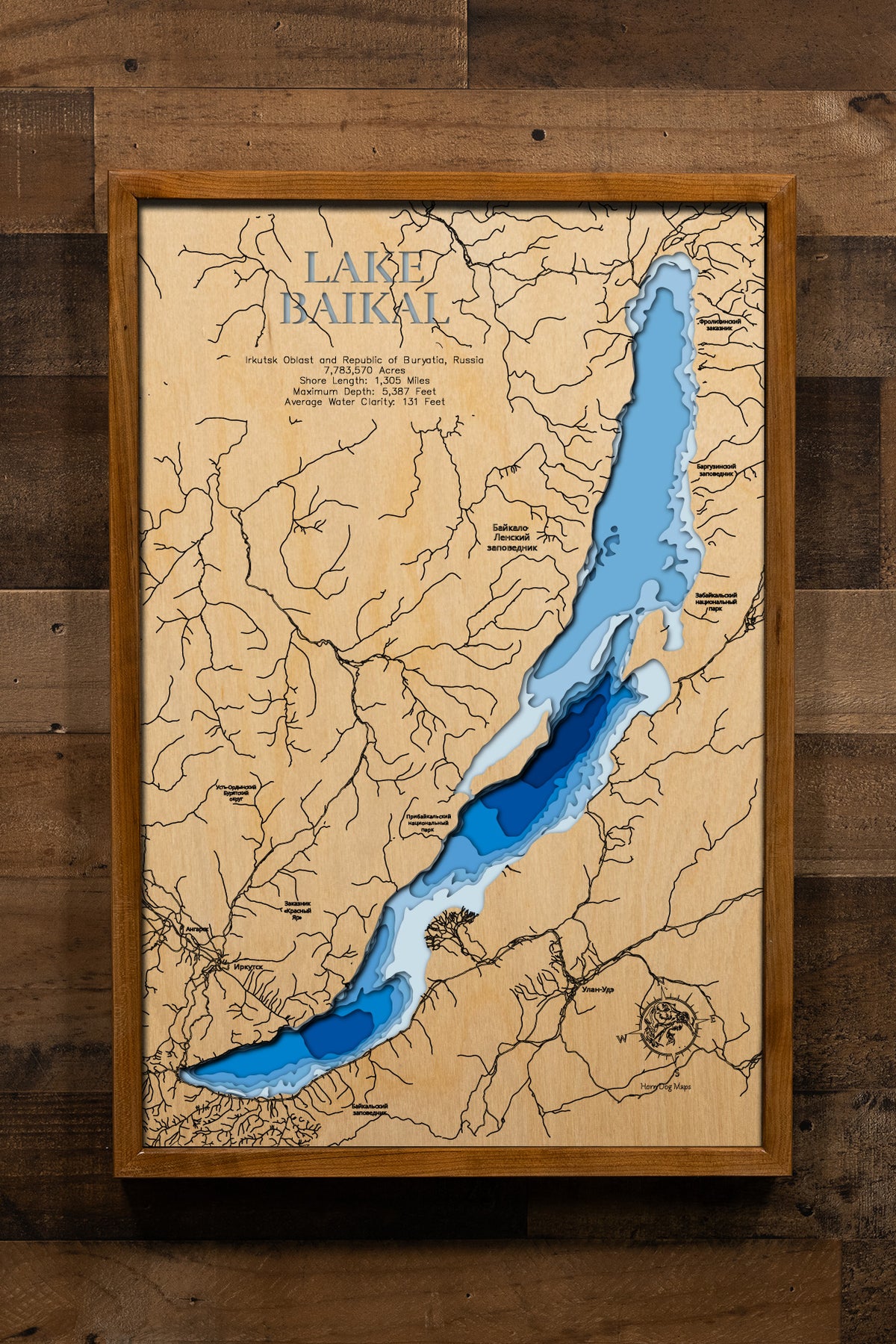
Lake Baikal in Irkutsk Oblast and Republic of Buryatia, Russia
Lake Baikal in Irkutsk Oblast and Republic of Buryatia, Russia
Couldn't load pickup availability
Lake Baikal in Irkutsk Oblast and Republic of Buryatia, Russia
This lake has 8 Layers or 15 Layers for HD Version
Lake Baikal is the world's oldest, deepest, and largest freshwater lake by volume, often called the Pearl of Siberia and the Sacred Sea by Russians. Formed approximately 25 to 30 million years ago in an ancient rift valley where Earth's crust continues to separate, this magnificent 7.8 million-acre crescent-shaped lake stretches 395 miles through southern Siberia and plunges to an astonishing maximum depth of 5,387 feet, with its bottom lying over 4,000 feet below sea level. The lake contains an incredible 5,670 cubic miles of water, representing 20 percent of the world's unfrozen surface freshwater, more than all five North American Great Lakes combined, making it truly one of Earth's most important natural treasures. Fed by 330 inflowing rivers including the mighty Selenga, Barguzin, and Upper Angara, with only the Angara River flowing out, Baikal is renowned as one of the clearest lakes on the planet with winter water transparency reaching 131 feet and summer visibility of 15 to 25 feet. Nicknamed the Galapagos of Russia, the lake hosts over 3,700 species of plants and animals, with approximately 80 percent found nowhere else on Earth, including the famous Baikal seal or nerpa, the world's only exclusively freshwater seal, the bizarre pink translucent golomyanka fish, 50 fish species including the prized omul, and over 1,500 invertebrate species thriving in the lake's well-oxygenated depths
Surrounded by majestic mountains including the Baikal Range, Barguzin Range, and Primorsky Range with peaks rising over 8,500 feet above the lake's surface, Lake Baikal sits between Irkutsk Oblast to the northwest and the Republic of Buryatia to the southeast. The lake features 27 islands with Olkhon being the largest at 45 miles long and the world's third-largest lake island, considered sacred by indigenous Buryat people and the spiritual center of shamanism with sites like the famous Shamanka Rock. The gateway city of Irkutsk, founded in the mid-17th century and located 45 miles from the lake, offers visitors historic wooden architecture, the Znamensky Orthodox Cathedral, the fascinating Museum of the Decembrists housed in revolutionary aristocrats' mansions, and the restored icebreaker Angara museum ship. Popular lakeside destinations include the resort village of Listvyanka with its Baikal Ecological Museum featuring live Baikal seals in aquariums, Taltsy Open-Air Museum showcasing centuries of indigenous Siberian wooden architecture, the Chersky Peak observation platform reached by cable car offering panoramic vistas, fresh omul fish markets, and access to the historic Circum-Baikal Railway built between 1896 and 1902 with 200 bridges and 33 tunnels hugging the southwestern shoreline. Outdoor enthusiasts enjoy the Great Baikal Trail system for hiking through pristine taiga forests of birch, larch, and Siberian pine, fishing for omul and perch, wildlife viewing including brown bears, Siberian red deer, and bald eagles, visiting thermal mineral springs, exploring Buddhist temples in nearby villages, and experiencing unique winter activities when the lake freezes solid with ice reaching 5 feet thick, allowing ice skating, dog sledding, driving across ice roads to Olkhon Island, and viewing spectacular transparent ice formations and caves
This magnificent laser-cut wooden map of Lake Baikal would make an extraordinary statement piece in your home, office, or mountain retreat, celebrating one of the world's most awe-inspiring natural wonders and UNESCO World Heritage Sites. The intricate handcrafted design captures the lake's distinctive 395-mile crescent shape curving through the Siberian landscape, featuring a natural wood top layer that elegantly showcases the 1,305 miles of dramatic shoreline with steep cliffs plunging into deep water, 27 islands including sacred Olkhon Island, major bays like Barguzin and Chivyrkuysky, the outlet of the Angara River, and the surrounding mountain ranges that cradle this ancient geological marvel. The water depth is breathtakingly illustrated through a graduated light blue to dark blue gradient that captures the dramatic depth variations from shallow coastal areas to the incredible 5,387-foot maximum depth in the Central Basin, visually representing the deepest continental rift on Earth and creating a stunning three-dimensional tribute to this 25-million-year-old living museum of evolution. Whether commemorating an unforgettable Trans-Siberian Railway journey, spiritual pilgrimage to shamanic sites, scientific research expedition, or simply honoring your connection to one of Earth's most pristine and scientifically significant ecosystems, this museum-quality artwork serves as both sophisticated conversation piece and cherished reminder of the profound beauty and ecological importance of the world's greatest lake
Dimensions:
Small: 8"x12"
Medium: 12"x18"
Large: 16"x24"
Extra Large: 20"x30"
XX Large: 24"x36"
Gigantic 30"x45"
HD Extra Large: 20"x30" - 15 Layers
HD XX Large: 24"x36" - 15 Layers
HD Gigantic 30"x45" - 15 Layers
The difference between standard and HD maps is the number of layers. Standard maps have 1 land layer and 7 water layers. " The HD lake maps have 1 land layer and 14 water layers. So twice the detail. The HD Maps are limited to Extra Large, " XX Large, and Gigantic sizes only. On the smaller sizes the depth change of the wood is too extreme and you end up losing detail.
Cribbage Boards - 10"x14" - Your choice of Maple or Cherry wood, 2 or 3 runs, and your choice of peg colors.
Share
About our Maps
Every map is designed and built in Minnesota. Nothing is outsourced and nothing is imported.
- Designed in-house. All art files are created by me, not purchased or reused
- True layered 3D construction. Not engraved or printed
- More layers, more detail. Most competitors use 3 to 7 layers. These use 8 or 15 layers
- Original blue depth gradient. Light to dark blue shows water depth clearly
- Handmade hardwood frames. Built from locally sourced rough sawn lumber, not pre-made frames
These are built to be the most accurate and most detailed 3D lake maps available.
Horn Dog Maps vs Others
True layered 3D construction
Horn Dog Maps: Yes
Other Companies: No
Etsy Sellers: Sometimes
Designed in-house (no purchased files)
Horn Dog Maps: Yes
Other Companies: Sometimes
Etsy Sellers: No
Made in Minnesota
Horn Dog Maps: Yes
Other Companies: No
Etsy Sellers: No
Number of layers
Horn Dog Maps: 8 or 15
Other Companies: 3 to 7
Etsy Sellers: 3 to 7
Blue depth gradient water
Horn Dog Maps: Yes
Other Companies: No
Etsy Sellers: No
Handmade hardwood frame included
Horn Dog Maps: Yes
Other Companies: No
Etsy Sellers: No
Uses multiple depth data sources
Horn Dog Maps: Yes
Other Companies: Sometimes
Etsy Sellers: No
Custom lakes without delays
Horn Dog Maps: Yes
Other Companies: No
Etsy Sellers: No
Connection to the lakes
Horn Dog Maps: Yes
Other Companies: No
Etsy Sellers: No
Frequently Asked Questions
Are these actually 3D or just engraved?
These are true 3D layered maps.
- Made from 1/8 inch Baltic birch
- Standard maps have 8 layers. 1 land layer and 7 water layers
- HD maps have 15 layers. 1 land layer and 14 water layers
Each water layer uses a light to dark blue gradient so depth changes are easy to see.
Where are these made?
Everything is made in my shop in Minnesota.
- Design
- Cutting
- Painting
- Assembly
- Frame building
The frames start as locally sourced rough sawn hardwood and are built from scratch.
Do you use real depth data?
Yes, as an angler and map nerd, accuracy matters to me. I use multiple data sources, up to six, to find the most accurate lake contours available.
I would not hang an inaccurate map in my house and I will not send one to yours.
Why buy from Horn Dog Maps instead of Etsy or marketplace sellers?
Most marketplace sellers:
- Buy pre-made cut files, often from overseas
- Have no connection to the lakes
- Cannot verify accuracy
- Have long delays if a file is not available
This leads to lower accuracy and longer lead times, often 6 to 8 weeks.
Because I design everything myself:
- I can create a new lake mockup in about 30 minutes
- You get a more accurate map, faster
What is your lead time?
Most orders ship in 1.5 to 2 weeks depending on the time of year.
Tell me about the Cribbage Boards
These are different from the layered maps and are not something you will find elsewhere.
- Made from a solid piece of Maple or Cherry
- The lake is engraved as if drained
- Then filled with blue tinted epoxy that is still transparent
You can see:
- Channels
- Humps
- Points
- Structure
Additional features:
- 2 or 3 track options
- Choice of peg colors
- Hidden peg storage with a magnetic dovetail slider
- Rubber feet so it does not slide on the table
It is a functional game board and a detailed lake model in one.