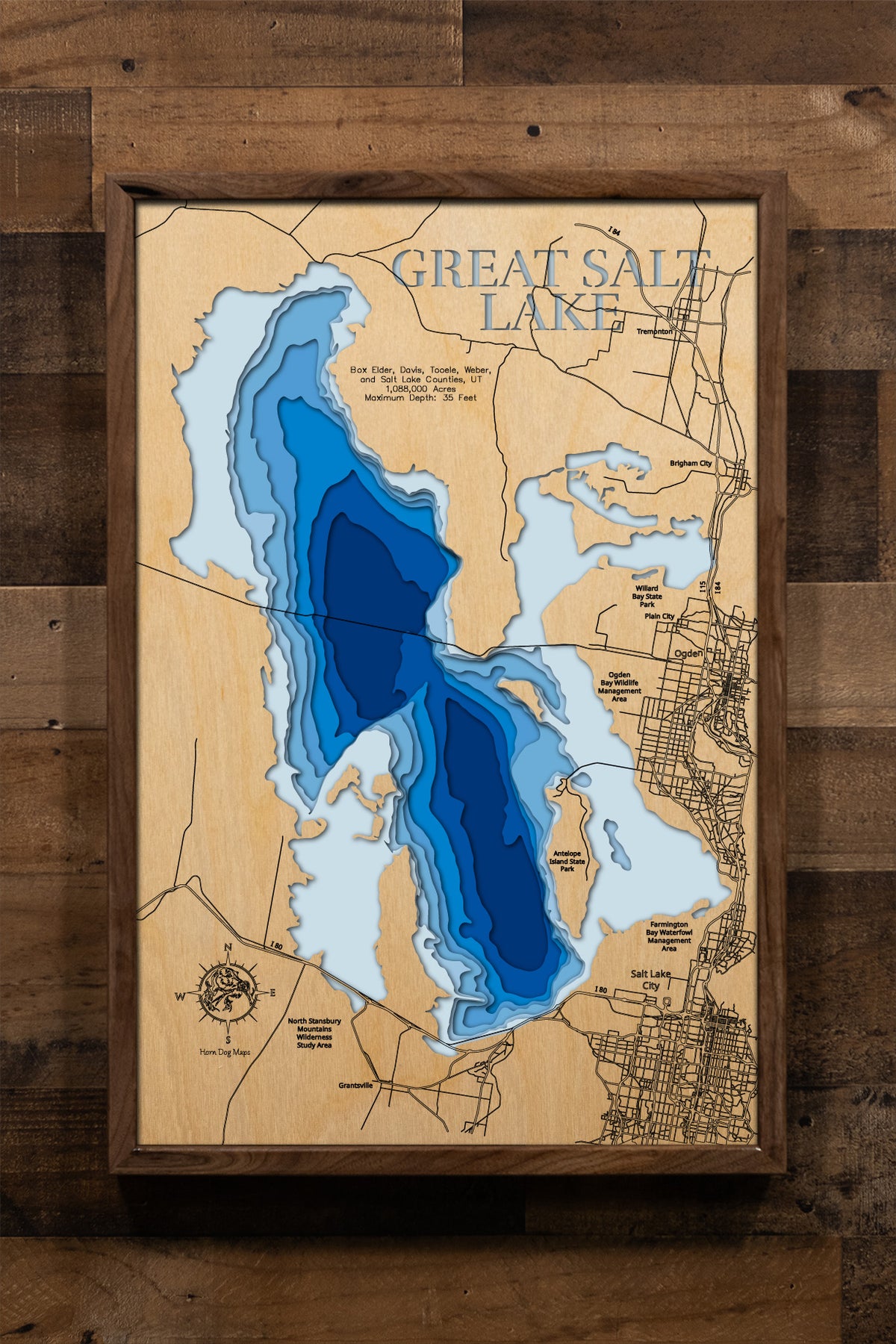
Great Salt Lake in Box Elder, Davis, Tooele, Weber, and Salt Lake Counties, Utah
This lake has 8 Layers or 15 Layers for HD Version
Great Salt Lake is the largest saltwater lake in the Western Hemisphere and the largest terminal lake in North America, covering approximately 1,088,000 acres (1,700 square miles) at its average elevation of 4,200 feet above sea level. This ancient remnant of prehistoric Lake Bonneville, which covered over 20,000 square miles during the Pleistocene Epoch approximately 30,000 years ago, stretches roughly 75 miles long by 35 miles wide in the Great Basin of northwestern Utah. The lake is remarkably shallow with a maximum depth of only 35 feet and an average depth of just 13 feet, causing its size to fluctuate dramatically based on precipitation, snowmelt, and evaporation rates—the lake has varied from as large as 2,300 square miles during high water years in the 1980s to as small as 950 square miles during the severe drought of 2022, with shoreline positions shifting as much as 15 to 20 miles during these fluctuations. Fed primarily by the Bear, Weber, and Jordan rivers with no outlet to the ocean, the lake loses an average of 2.6 billion gallons of water daily through evaporation, leaving behind dissolved minerals and salts that make the water typically three to nine times saltier than the ocean, with salinity varying across different sections of the lake. A rock-fill railroad causeway built in 1959, known as the Lucin Cutoff, divides the lake into distinct northern and southern sections, creating different salinity levels and creating unique aquatic environments including the highly saline Gunnison Bay in the north and the less-salty Gilbert Bay in the south. The lake contains eleven islands, with 28,000-acre Antelope Island being the largest, along with Fremont Island, Stansbury Island, and several smaller islands that sometimes become connected to the mainland as peninsulas during low water periods
Great Salt Lake serves as a globally significant ecosystem and recreational destination, designated as a Western Hemisphere Shorebird Reserve Network site supporting over seven million birds from 257 species annually, including up to 1.5 million shorebirds during peak migration periods such as Wilson's Phalaropes, American Avocets, and Black-necked Stilts. The lake's 400,000 acres of surrounding freshwater wetlands—comprising 75 percent of Utah's total wetlands—provide critical habitat including the Bear River Migratory Bird Refuge, numerous state Wildlife Management Areas, and protected lands managed by conservation organizations. The lake supports a thriving brine shrimp industry that harvests and processes these unique crustaceans for the aquaculture trade worldwide, along with mineral extraction operations producing table salt, potash, and magnesium from the saline waters. Antelope Island State Park, the crown jewel of Great Salt Lake recreation, offers visitors the chance to swim in the ultra-buoyant salty water at white sand beaches, hike over 20 miles of scenic trails including the summit trail to Frary Peak with spectacular lake and mountain views, observe free-roaming herds of American bison and pronghorn antelope, enjoy camping at three campgrounds with stunning sunrises and sunsets, mountain bike on backcountry roads and trails, tour the historic 1850s Fielding Garr Ranch, and experience Dark Sky Park stargazing opportunities. The Great Salt Lake State Park and Marina on the southern shore provides sailing, powerboating, and kayaking access with full-service facilities, while the nearby Bonneville Salt Flats, located 90 miles west and covering 30,000 acres as another remnant of Lake Bonneville, offers unique opportunities to witness and photograph the otherworldly flat white landscape famous for land speed records. Salt Lake City, located just 25 miles southeast of Antelope Island, serves as the gateway to the lake and offers urban amenities, cultural attractions, and easy access to this remarkable natural wonder that continues to inspire awe and provides essential ecological services despite ongoing challenges from drought, climate change, and water diversions
Dimensions:
Small: 8"x12"
Medium: 12"x18"
Large: 16"x24"
Extra Large: 20"x30"
XX Large: 24"x36"
Gigantic 30"x45"
HD Extra Large: 20"x30" - 15 Layers
HD XX Large: 24"x36" - 15 Layers
HD Gigantic 30"x45" - 15 Layers
The difference between standard and HD maps is the number of layers. Standard maps have 1 land layer and 7 water layers. " The HD lake maps have 1 land layer and 14 water layers. So twice the detail. The HD Maps are limited to Extra Large, " XX Large, and Gigantic sizes only. On the smaller sizes the depth change of the wood is too extreme and you end up losing detail.
Cribbage Boards - 10"x14" - Your choice of Maple or Cherry wood, 2 or 3 runs, and your choice of peg colors.