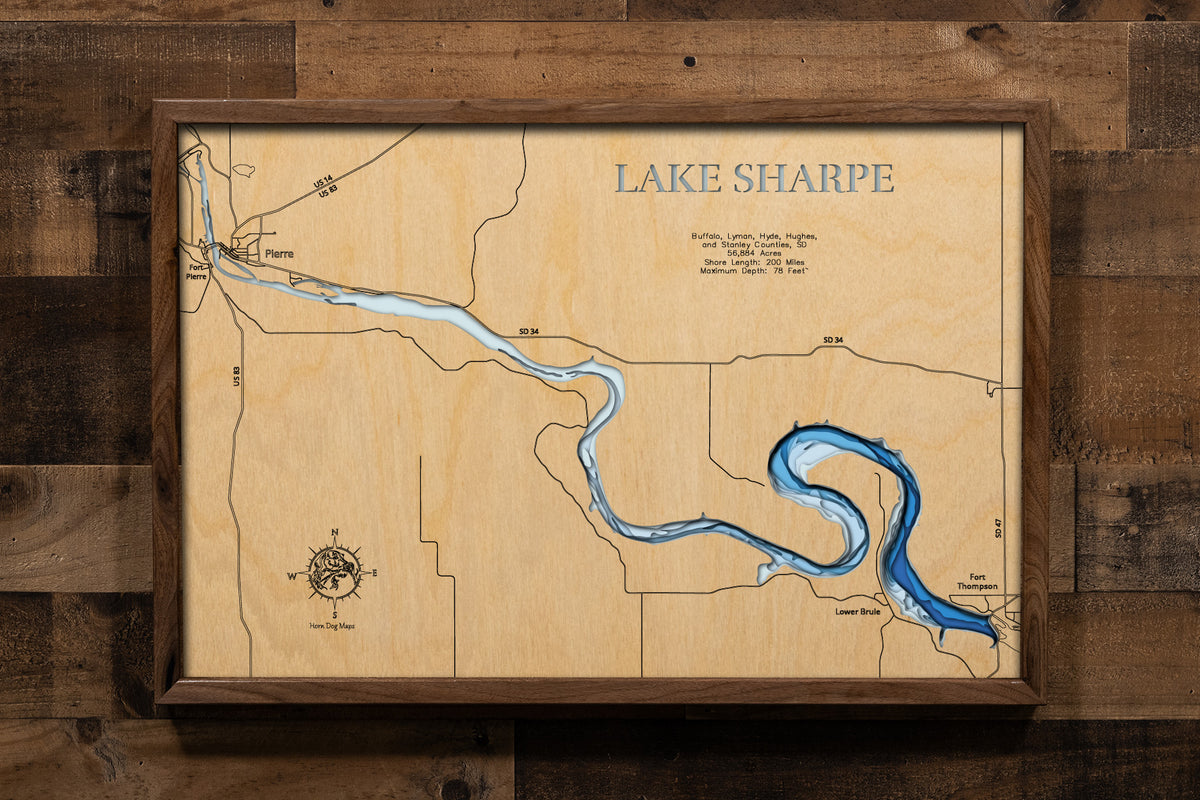
Lake Sharpe in Buffalo, Lyman, Hyde, Hughes, and Stanley Counties, South Dakota
This map has 8 layers
Lake Sharpe is a massive 56,884-acre reservoir impounded by Big Bend Dam on the Missouri River in central South Dakota, ranking as the 54th largest reservoir in the United States. Created as part of the Pick-Sloan Plan and authorized by the Flood Control Act of 1944, construction of Big Bend Dam began in 1959 with the embankment completed in July 1963, power generation beginning in 1964, and the entire complex finished in 1966 at a cost of $107 million. Named in honor of Merrill Q. Sharpe, the 17th Governor of South Dakota, this serpentine reservoir stretches approximately 80 miles upstream from Fort Thompson to Oahe Dam near Pierre, the state capital, following the historic course of the Mighty Missouri River. With a maximum depth of 78 feet and 200 miles of scenic shoreline, Lake Sharpe features distinctive characteristics along its length, with the upper third near Pierre exhibiting river-like qualities with common depths between 5-15 feet, while the lower third near Big Bend Dam functions more like a traditional lake with depths reaching the maximum 78 feet. The reservoir's most notable geographical feature is the Big Bend itself, located about seven miles north of the dam, where the Missouri River makes an almost complete loop, traveling 25 miles around a horseshoe bend before returning to a narrow neck of land less than one mile wide, creating one of the largest river meanders in the nation. Much of the western shore lies within the Lower Brule Indian Reservation, while the eastern shore borders the Crow Creek Indian Reservation, with both tribes having lost extensive fertile bottomlands when the government acquired property that would be flooded by the reservoir
Lake Sharpe has earned its reputation as a premier walleye factory and action fishery, consistently producing strong numbers of quality walleye year after year, with Pierre locals affectionately referring to the reservoir as "the river." Anglers can expect to catch abundant 15-18 inch walleye, with plenty of fish over 20 inches and trophy specimens in the 27-30 inch range also available, supported by consistent year-classes that keep the fishery thriving. The reservoir hosts a diverse multispecies fishery including sauger, smallmouth bass, channel catfish, flathead catfish, northern pike, white bass, yellow perch, black crappie, and rainbow trout, with smallmouth bass fishing particularly excellent on the lower end between West Bend and the dam face, and white bass providing opportunities to catch hard-fighting fish by the bucketful. The lake's healthy ecosystem is driven by warm water springs and wells within Hipple Lake near Farm Island Recreation Area, where gizzard shad survive South Dakota winters and disperse throughout the reservoir as primary forage for walleye and other gamefish. Over 80,000 acres of public land and water surround Lake Sharpe, with the South Dakota Department of Game, Fish, and Parks maintaining numerous recreation areas and boat launching facilities including West Bend Recreation Area and Farm Island State Recreation Area, while the U.S. Army Corps of Engineers operates Left Tailrace Campground with 81 electrical and 12 non-electrical sites, complete with comfort stations, showers, fish cleaning stations, boat ramps, and disc golf. Wildlife viewing opportunities abound with tribal bison herds grazing the grasslands north of Fort Thompson and Lower Brule, excellent waterfowl and upland game bird hunting along shoreline areas, and resident bald eagles roosting in trees near Oahe Dam. The reservoir serves multiple purposes including flood control, hydroelectric power generation producing 493,300 kilowatts at maximum capacity, irrigation, fish and wildlife habitat, and extensive recreational opportunities, making Lake Sharpe a cornerstone of outdoor life in central South Dakota and a destination for anglers, boaters, campers, and wildlife enthusiasts from across the Great Plains
Dimensions:
Small: 8"x12"
Medium: 12"x18"
Large: 16"x24"
Extra Large: 20"x30"
XX Large: 24"x36"
Gigantic 30"x45"
Cribbage Boards - 10"x14" - Your choice of Maple or Cherry wood, 2 or 3 runs, and your choice of peg colors.