

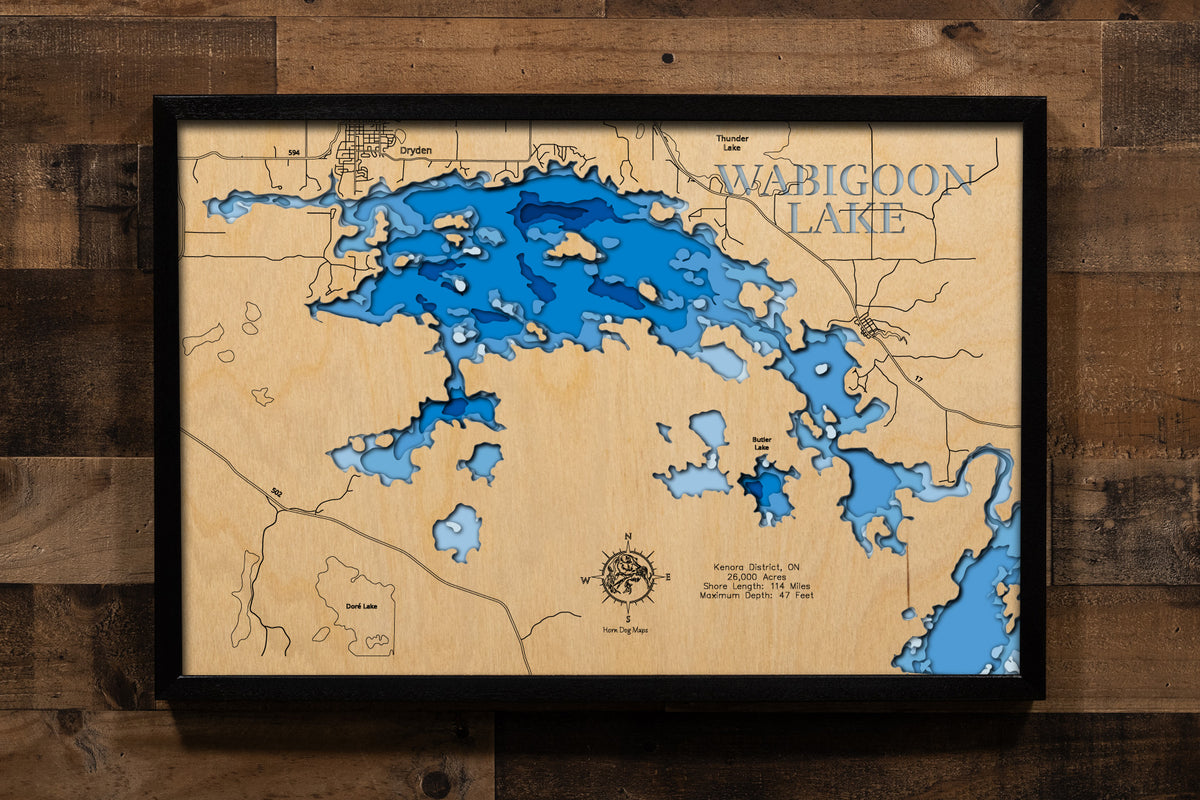
Wabigoon Lake in Kenora District, Ontario
Wabigoon Lake in Kenora District, Ontario
Couldn't load pickup availability
Wabigoon Lake in Kenora District, Ontario
This lake has 8 Layers or 15 Layers for HD Version
Wabigoon Lake is a legendary 26,000-acre freshwater lake in northwestern Ontario's Kenora District stretching 20 miles long with an average depth of 20 feet reaching a maximum depth of 47 feet and an impressive 114 miles of shoreline, making it one of Ontario's premier fishing destinations. The lake is part of a nine-lake Wabigoon-Dinorwic chain covering over 50,000 combined acres, fed by the Wabigoon River and several creeks creating nutrient-rich, warm waters that produce trophy fish and seemingly inexhaustible populations. Designated as a top trophy muskie lake with special 54-inch minimum size regulations protecting these apex predators, many biologists predict the next world record muskie may come from Wabigoon's waters where 50-plus-inch fish are caught weekly and occasional giants reach 55 inches. The lake supports exceptional populations of Walleye commonly ranging 14 to 18 inches with frequent catches in the 20-to-30-plus-inch range, Northern Pike in the 2-to-12-pound range with trophy fish regularly exceeding these sizes, Smallmouth Bass averaging 12 to 16 inches with many reaching 18 to 20 inches, plus abundant Jumbo Perch, Black Crappie increasing in size and numbers annually, and even Lake Trout in nearby connected Dinorwic Lake. With hundreds of islands including larger ones like Green Island, Christie's Island, Stewart Island, Devil's Island, and Grenville Island, plus countless bays with weed beds such as Muckie Bay, Barrett Bay, Daunais Bay, and the Western Arm, the lake offers endless fishing structure and year-round recreation including boating, water skiing, kayaking, swimming, and exceptional ice fishing
Located adjacent to the city of Dryden (population 8,200) on the lake's north shore along Highway 17 in the heart of Sunset Country, Wabigoon Lake sits approximately two hours north of the Canada-US border, three and a half hours from Winnipeg, and halfway between Winnipeg and Thunder Bay. The name derives from the Ojibwe "waabigon" meaning marigold or "waabi-miigwan" meaning white feather, reflecting the area's rich Indigenous heritage. Dryden offers the Dryden & District Museum showcasing over 10,000 artifacts including the famous Dryden Buck (unofficial Ontario record whitetail scoring 192 7/8 Boone and Crockett) and five thousand years of local history, the Roy Wilson Suspension Bridge spanning the Wabigoon River accessed from Johnston Park with the beautiful Pieces of Dryden tile mosaic, and Max the Moose statue downtown. The surrounding area provides exceptional outdoor recreation at Aaron Provincial Park on Thunder Lake with sandy beaches, camping, and canoe routes connecting to major waterways, Blue Lake Provincial Park 28 miles away featuring crystal clear water visible six meters deep with a long sandy beach and rock climbing, and the annual Trailblazer Tagged Fish Contest awarding thousands of dollars for catching tagged fish. Visitors can explore 25-plus kilometers of urban trails including the Dryden Signature Trail, attend vibrant pow wows at neighboring Eagle Lake First Nation and Wabigoon Lake Ojibway Nation celebrating Indigenous culture, fish nearby lakes for Lake Trout, and enjoy year-round activities including cross-country skiing, snowmobiling on extensive trail networks, and hunting for trophy whitetail deer as Dryden has been recognized as one of Canada's hottest spots for big bucks
This magnificent handcrafted laser-cut wooden topographical map of Wabigoon Lake would create a breathtaking statement piece in your Ontario fishing lodge, lake cottage, or home, celebrating your connection to this legendary trophy muskie and walleye destination. The artistic design features a natural wood top layer that beautifully showcases the lake's expansive 20-mile length, 114 miles of intricate shoreline with hundreds of islands, the multiple productive bays, the Wabigoon River inlet and outlet, and connections to the nine-lake chain system spanning over 50,000 acres. The water depths are represented through a captivating gradient flowing from light blue in the shallow 20-foot average areas and warm, weedy bays to rich deep blue at the 47-foot maximum depth, while every island, rocky point, shoal, feeder stream, depth contour, and prime fishing structure is precisely laser-etched into the multi-layered wood construction. This three-dimensional masterpiece beautifully captures the productive character, world-class muskie fishing heritage, and natural beauty of this Sunset Country gem where the next world record muskie may be swimming
Dimensions:
Small: 8"x12"
Medium: 12"x18"
Large: 16"x24"
Extra Large: 20"x30"
XX Large: 24"x36"
Gigantic 30"x45"
HD Extra Large: 20"x30" - 15 Layers
HD XX Large: 24"x36" - 15 Layers
HD Gigantic 30"x45" - 15 Layers
The difference between standard and HD maps is the number of layers. Standard maps have 1 land layer and 7 water layers. " The HD lake maps have 1 land layer and 14 water layers. So twice the detail. The HD Maps are limited to Extra Large, " XX Large, and Gigantic sizes only. On the smaller sizes the depth change of the wood is too extreme and you end up losing detail.
Cribbage Boards - 10"x14" - Your choice of Maple or Cherry wood, 2 or 3 runs, and your choice of peg colors.
Share

About our Maps
Every map is designed and built in Minnesota. Nothing is outsourced and nothing is imported.
- Designed in-house. All art files are created by me, not purchased or reused
- True layered 3D construction. Not engraved or printed
- More layers, more detail. Most competitors use 3 to 7 layers. These use 8 or 15 layers
- Original blue depth gradient. Light to dark blue shows water depth clearly
- Handmade hardwood frames. Built from locally sourced rough sawn lumber, not pre-made frames
These are built to be the most accurate and most detailed 3D lake maps available.
Horn Dog Maps vs Others
True layered 3D construction
Horn Dog Maps: Yes
Other Companies: No
Etsy Sellers: Sometimes
Designed in-house (no purchased files)
Horn Dog Maps: Yes
Other Companies: Sometimes
Etsy Sellers: No
Made in Minnesota
Horn Dog Maps: Yes
Other Companies: No
Etsy Sellers: No
Number of layers
Horn Dog Maps: 8 or 15
Other Companies: 3 to 7
Etsy Sellers: 3 to 7
Blue depth gradient water
Horn Dog Maps: Yes
Other Companies: No
Etsy Sellers: No
Handmade hardwood frame included
Horn Dog Maps: Yes
Other Companies: No
Etsy Sellers: No
Uses multiple depth data sources
Horn Dog Maps: Yes
Other Companies: Sometimes
Etsy Sellers: No
Custom lakes without delays
Horn Dog Maps: Yes
Other Companies: No
Etsy Sellers: No
Connection to the lakes
Horn Dog Maps: Yes
Other Companies: No
Etsy Sellers: No
Frequently Asked Questions
Are these actually 3D or just engraved?
These are true 3D layered maps.
- Made from 1/8 inch Baltic birch
- Standard maps have 8 layers. 1 land layer and 7 water layers
- HD maps have 15 layers. 1 land layer and 14 water layers
Each water layer uses a light to dark blue gradient so depth changes are easy to see.
Where are these made?
Everything is made in my shop in Minnesota.
- Design
- Cutting
- Painting
- Assembly
- Frame building
The frames start as locally sourced rough sawn hardwood and are built from scratch.
Do you use real depth data?
Yes, as an angler and map nerd, accuracy matters to me. I use multiple data sources, up to six, to find the most accurate lake contours available.
I would not hang an inaccurate map in my house and I will not send one to yours.
Why buy from Horn Dog Maps instead of Etsy or marketplace sellers?
Most marketplace sellers:
- Buy pre-made cut files, often from overseas
- Have no connection to the lakes
- Cannot verify accuracy
- Have long delays if a file is not available
This leads to lower accuracy and longer lead times, often 6 to 8 weeks.
Because I design everything myself:
- I can create a new lake mockup in about 30 minutes
- You get a more accurate map, faster
What is your lead time?
Most orders ship in 1.5 to 2 weeks depending on the time of year.
Tell me about the Cribbage Boards
These are different from the layered maps and are not something you will find elsewhere.
- Made from a solid piece of Maple or Cherry
- The lake is engraved as if drained
- Then filled with blue tinted epoxy that is still transparent
You can see:
- Channels
- Humps
- Points
- Structure
Additional features:
- 2 or 3 track options
- Choice of peg colors
- Hidden peg storage with a magnetic dovetail slider
- Rubber feet so it does not slide on the table
It is a functional game board and a detailed lake model in one.